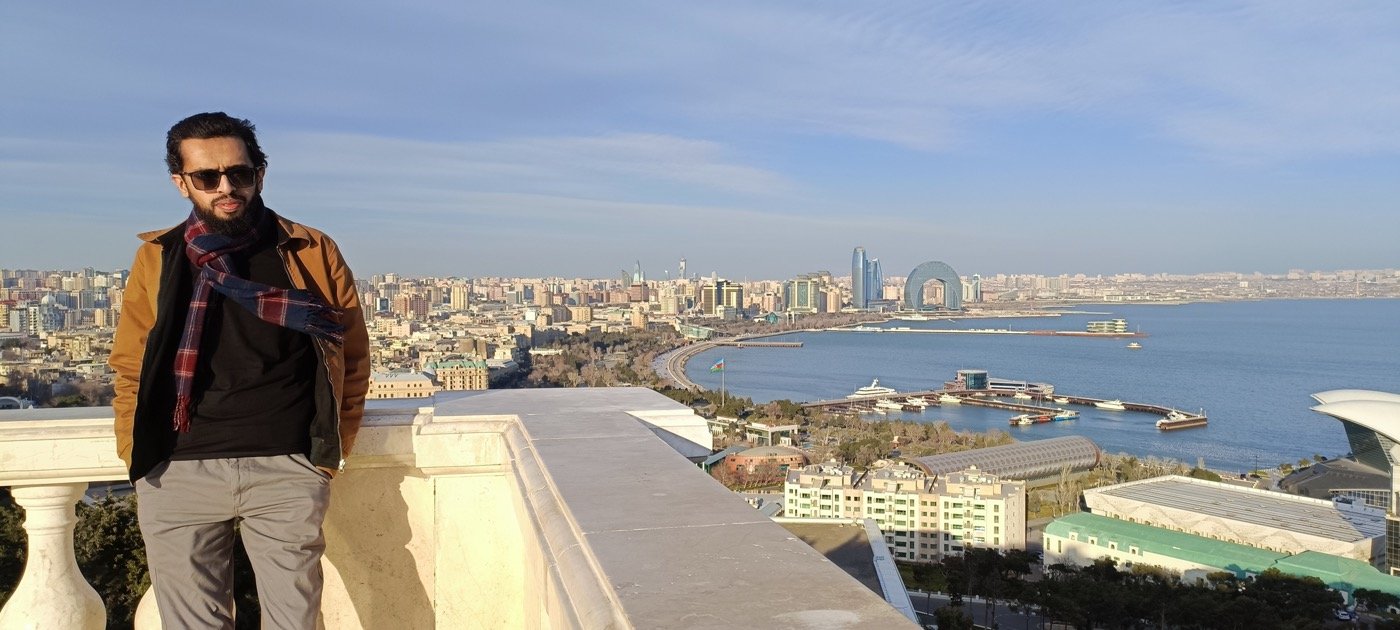
Azerbaijan does not come up when Pakistanis talk about business travel. People think Dubai, Malaysia, maybe Sri Lanka. But Baku is quietly becoming one of the most interesting destinations for Pakistani entrepreneurs: direct flights, a brand new Preferential Trade Agreement, a Pakistani community already rooted there, and a country sitting right at the crossroads of Europe, Asia and the Middle East. I visited Baku and what I saw on the ground surprised me. This is the full picture.
My Azerbaijan travel video. Everything a Pakistani needs to know before visiting Baku.
Visa Policy for Pakistanis
Pakistani citizens cannot get a visa on arrival in Azerbaijan. You need to apply in advance: but the good news is that the e-visa system is simple, fully online and typically approved within 3–5 business days. There is no embassy visit required unless you prefer it.
- Portal: evisa.gov.az
- Processing time: 3–5 business days (standard) / same day (urgent)
- Validity: 30 days from date of arrival, single entry
- Cost: Approx. USD 20–23 (standard) · USD 50–55 (urgent)
- Documents needed: Passport (6 months validity), photo, travel dates, hotel booking
Apply Online
Go to evisa.gov.az, fill in your details, upload your passport scan and a recent photo. The form takes about 10 minutes.
Pay the Fee
Payment is by credit or debit card. Standard fee is approximately USD 20–23. An urgent option is available if you need approval the same day for a higher fee.
Receive Your E-Visa
The approved visa arrives by email as a PDF. Print it or save it digitally. No sticker required: the visa number is verified electronically at the border.
Embassy Route (Optional)
If you prefer, the Azerbaijan Embassy in Islamabad processes visas in person. Useful for business visas requiring an invitation letter from an Azerbaijani company.
For a business trip rather than tourism, request a business visa via the embassy. You will need an invitation letter from your Azerbaijani partner or the Chamber of Commerce. The business visa can be extended more easily and allows multiple entries.
Getting There from Pakistan
The flight situation between Pakistan and Azerbaijan has changed dramatically. Until 2024, there were no direct options and you had to connect via Dubai, Istanbul or Doha with total travel times of 8–12 hours. That changed with the launch of direct routes, which is the main reason Pakistani visitor numbers jumped 47% in a single year.
Direct Flights
PIA: Lahore (LHE) to Baku (GYD)
Launched March/April 2025 · 2 flights per week (Wednesday & Sunday) · ~5 hrs 5 min · Watch my flight experience →
PIA: Karachi (KHI) to Baku (GYD)
Launched March 16, 2025 · Direct service · ~5–6 hrs
AZAL (Azerbaijan Airlines): Islamabad (ISB) to Baku (GYD)
Azerbaijan's national carrier operating its own direct route · ~3 hrs 35 min · The shortest flight time of all Pakistan–Baku routes
Airblue: Lahore (LHE) to Baku (GYD)
Launched May 2026 · Expanding competition on the Lahore–Baku corridor
Round-trip fares on PIA start from approximately USD 440 before taxes. With Airblue entering the market, expect competitive pricing on the Lahore route.
Connecting Options
If direct flights are full or you want more flexibility, the best connections are via Istanbul (Turkish Airlines), Dubai (Emirates/flydubai) or Doha (Qatar Airways). Total travel time via Istanbul is around 7–8 hours with a short layover, making it a comfortable option.
Pakistan–Azerbaijan: A Rapidly Growing Partnership
The relationship between Pakistan and Azerbaijan has accelerated in a way that most people are not aware of. On the surface it looks like two countries that are geographically far apart with limited trade. Look closer and you find a defense deal worth over a billion dollars, a brand new trade agreement, shared positions on Kashmir and Karabakh, and both governments publicly targeting $2 billion in bilateral trade.
The JF-17 Block III Deal: $1.6 Billion
In February 2024, Azerbaijan signed a contract to purchase JF-17 Block III fighter jets from Pakistan: the largest defense export deal in Pakistan's history at that time. Azerbaijan became the first export customer for the JF-17 Block III variant. By 2025, reports indicated Azerbaijan was considering expanding the order to 40 units worth $4.6 billion. This single deal transformed the strategic relationship between the two countries and opened the door for broader economic cooperation.
Preferential Trade Agreement (PTA)
Signed in December 2023 and brought into force on December 16, 2024 after FBR announced the tariff concessions, the Pakistan–Azerbaijan PTA is the formal trade framework the business community had been waiting for. Key concessions:
- Azerbaijan → Pakistan: 100% tariff reduction on hazelnuts, apricots, polyethylene and tobacco
- Pakistan → Azerbaijan: 66% reduction on bananas, dates, leather gloves and safety razors
- More products and sectors are in the pipeline as the two sides work toward the $2 billion target
Transit Trade Agreement
A Transit Trade Agreement allows Azerbaijani vehicles to enter Pakistan via Karachi Port, Port Qasim and Gwadar Port. For Pakistani businesses, this creates logistics and warehousing opportunities along the corridor: goods moving between Azerbaijan, Central Asia and Pakistan can be facilitated through Pakistani ports under this framework.
Azerbaijan's state oil company SOCAR signed an MoU with Pakistan's FWO and PSO for collaboration on the Machike–Thallian–Tarujabba White Oil Pipeline: a major infrastructure project running from Karachi to KPK. This opens direct engineering and construction opportunities for Pakistani firms working with or alongside SOCAR.
Pakistani Community in Azerbaijan
According to the Pakistan Embassy in Baku, fewer than 1,500 Pakistanis currently live in Azerbaijan on a long-term basis. These are the official figures sourced from the Pakistan Ministry of Foreign Affairs (MOFA), Embassy Baku. What makes the number interesting is the contrast: while only 1,500 Pakistanis are officially registered, 3,706 Pakistani companies are registered in Azerbaijan (announced by Azerbaijan's Deputy Minister of Economy at the Pakistan–Azerbaijan Business Forum in Baku, 2024). Most of those registrations are for trade, import-export or financial services: Pakistani entrepreneurs using Azerbaijan as a business hub without necessarily living there full time.
Honestly, I seriously doubt these figures. Every time I have been to Baku, I have seen far more Pakistanis than what these official numbers suggest. The MOFA data may simply not be updated regularly — many Pakistanis living and working there may never have formally registered with the Embassy. The real number on the ground feels significantly higher.
The resident community itself is made up of several different groups: students enrolled at Azerbaijani universities, professionals on work visas in engineering, construction and trade, families who followed a working spouse, and a smaller number of Pakistanis who married Azerbaijani nationals, settled permanently and eventually obtained Azerbaijani citizenship. This last group is particularly interesting: they have fully integrated into Azerbaijani life, many of them now speaking Azerbaijani fluently.
That language point matters if you are planning to live or do long-term business there. Azerbaijani is the official language and while Russian is widely spoken by older generations and English is growing in business circles, if you live in Azerbaijan outside the Baku business district, you will face a real language barrier. The Pakistanis who have settled there long-term will tell you the same: learning Azerbaijani is not optional, it is essential for daily life.
Who Is Already There
- Students: several hundred Pakistani students study at Azerbaijani universities, drawn by affordable tuition fees and the Muslim-majority environment
- Work visa holders: professionals in construction, engineering, trade facilitation and small business
- Families: spouses and children of those who came for work and stayed
- Settled community: Pakistanis who married Azerbaijani nationals and built their lives there: some now hold Azerbaijani nationality and are fully bilingual
English will get you through business meetings in Baku's city centre. It will not get you through daily life outside it. Azerbaijani is a Turkic language: completely different from Urdu, Arabic or Farsi. If you are planning to move there, factor in serious language learning time. The Pakistanis who thrive long-term in Azerbaijan are the ones who committed to learning the language.
Azerbaijani Content Creators: The Pakistan Connection
One visible sign of how Pakistan and Azerbaijan have been quietly connecting is the growing number of Azerbaijani women content creators whose husbands are Pakistani. Several of them document their intercultural family life: Azerbaijani-Pakistani households, bilingual children, navigating two very different cultures that share a Muslim foundation. These creators have built real audiences in both countries and represent something genuine: that beyond trade deals and defense agreements, there are real families being built across this bridge. It is the kind of human connection that business eventually follows.
- APJCCI (Azerbaijan–Pakistan Joint Chamber of Commerce and Industry): active business promotion body with members in both countries. Website: apjcci.com
- PAKAZCHAM: Pakistan–Azerbaijan Chamber of Economic Cooperation, formally inaugurated in Islamabad on February 12, 2025. Plans to open a parallel chamber in Baku.
- Pakistan–Azerbaijan–Turkey Business Council: trilateral body reflecting the strategic Turkey–Pakistan–Azerbaijan axis
Pakistanis Are Already Discovering Baku
One thing that struck me when I looked at the data is how fast Pakistani tourism to Azerbaijan is growing. In 2024, Pakistan ranked as the 8th largest source of tourists to Azerbaijan: ahead of many European countries. That position was not there two or three years ago.
| Year | Pakistani Visitors | Share of Total | Trend |
|---|---|---|---|
| 2022 | ~35,000–40,000 | ~1.5% | — |
| 2023 | ~50,000–55,000 | ~2.5% | ↑ Growing |
| 2024 | ~72,000–80,924 | ~3.0–3.1% | ↑ +47% YoY |
| Source: Azerbaijan State Statistical Committee, 2024. Pakistan ranked 8th among all source countries. | |||
The top source countries ahead of Pakistan are Russia (28.2%), Turkey (16.1%), India (8.9%), Iran (8%), Georgia (4.1%), Saudi Arabia (3.9%) and Kazakhstan (3.3%). Pakistan at 3% with 47% year-on-year growth is a significant market that has accelerated almost entirely because of the new direct flight connections.
Real Business Opportunities
Based on what I saw in Baku, what the trade data shows and what both governments are formally discussing, these are the sectors where Pakistani entrepreneurs and investors have a genuine opening right now.
Trade & Import/Export
The most immediate opportunity. The PTA (in force since December 2024) gives tariff advantages on key Pakistani exports: textiles, rice, sports goods, pharmaceuticals, surgical instruments and leather goods. Azerbaijan sends fertilizers and petrochemicals in return. With only $28.8M in bilateral trade currently against a $2B target, the gap is an opportunity.
Textiles & Garments
Pakistan's textile exports reached $17.9 billion in FY 2024–25. Azerbaijani retailers and wholesalers are an underserved market: fabrics, ready-made garments and home textiles from Pakistan are already among the top exports but at a small scale. Physical presence via a showroom or agent in Baku can unlock this.
Pharmaceuticals
Pakistan's pharma exports exceed $421M globally. Azerbaijan is identified as a growth market and is explicitly named in the PTA framework. Generic medicines and active pharmaceutical ingredients (APIs) from Pakistan are competitively priced against European alternatives. Regulatory registration with the Azerbaijan Medicines Agency is the entry step.
Information Technology
Azerbaijan's ICT sector is 1.9% of GDP and growing. The government is actively seeking technology partners as part of its economic diversification strategy. Pakistani IT firms offering software development, mobile apps, fintech solutions and outsourced services can find clients in Baku's emerging tech market at a lower cost base than European competitors.
Halal Food & F&B
Azerbaijan launched its first national halal certification framework and hosted the Azerbaijan Halal Business Forum (AZHAB) in 2024. The country is positioning itself as a halal tourism hub. Pakistani exporters of halal-certified rice, meat, processed foods and spices have a clear, formally recognized entry point. Pakistani restaurants in Baku are also virtually nonexistent: significant gap for an F&B entrepreneur.
Construction & Engineering
Azerbaijan is spending over $910 million on reconstruction in recaptured Karabakh territories. Baku itself is expanding rapidly. Pakistani construction firms and civil engineers have strong regional experience. The SOCAR–FWO pipeline collaboration is a proof point that Pakistani engineering capability is already being mobilized in Azerbaijan's infrastructure projects.
Real Estate
Baku's real estate market is growing with new developments across the city. Azerbaijani firm PASHA Real Estate has already held promotional events in Pakistan to attract Pakistani investors to Baku property projects: a direct signal that they see Pakistani capital as a target market. Entry-level investment is accessible compared to Dubai.
Travel & Tourism Services
With 80,000+ Pakistanis visiting Azerbaijan in 2024 and growing, there is a real gap in Urdu-speaking hospitality, Pakistan-focused travel agencies, halal-certified accommodation and tour guides who understand what Pakistani visitors want. A travel business or hospitality operation catering specifically to South Asian visitors is an underserved niche in Baku right now.
The Alat Free Economic Zone
If you are considering setting up a manufacturing or trading operation in Azerbaijan, the Alat Free Economic Zone (AFEZ) is worth understanding in detail. It is one of the most significant incentive zones in the Caucasus region and is specifically designed to attract foreign businesses.
Located near the Baku International Sea Trade Port, at the intersection of the North–South and East–West transport corridors, AFEZ covers 850 hectares with reserved expansion land of over 7,000 hectares. The World Bank's IFC is a formal supporter of businesses in the zone.
For a Pakistani manufacturer in textiles, pharmaceuticals, food processing or light engineering, setting up a unit in AFEZ means access to Azerbaijani and regional markets with zero corporate tax, no import duties on raw materials and zero VAT on production. Goods produced here can be exported duty-free to the 10 countries with which Azerbaijan has free trade agreements, including Georgia, Moldova and CIS states.
Applications are processed through the Alat Free Economic Zone Authority. Visit afez.az for current investor requirements. The APJCCI (apjcci.com) also facilitates introductions for Pakistani companies seeking entry into AFEZ.
Baku as the Middle Corridor Hub
One of the most underappreciated aspects of Azerbaijan's strategic position is what has happened to global logistics since 2022. Russia's invasion of Ukraine effectively disrupted the northern trade corridors that connected China and Central Asia to Europe. The alternative: the Middle Corridor or Trans-Caspian International Transport Route: runs directly through Azerbaijan.
The route connects: China → Central Asia → Caspian Sea → Azerbaijan → Georgia → Turkey → Europe. It bypasses both Russia and Iran. In the first 11 months of 2024, cargo through this corridor grew 63% year-on-year, reaching 4.1 million tons. The EU is actively investing in it as a strategic alternative to Chinese- and Russian-controlled routes.
Baku sits at the heart of this. The Baku International Sea Trade Port currently handles 15 million tons annually with a Phase 2 expansion to 25 million tons underway. The Baku–Tbilisi–Kars (BTK) railway connects onward to Turkey and Europe. Pakistan's Transit Trade Agreement means Azerbaijani goods can enter via Karachi or Gwadar: and the same corridor works in reverse.
A Pakistani logistics or trading company with a registered presence in Baku can use Azerbaijan as a regional distribution hub: connecting Pakistani goods to Central Asian markets (Kazakhstan, Uzbekistan, Turkmenistan), Georgia, Turkey and onward to Europe through a single Baku base. The infrastructure is already there. The corridor is growing fast. The Pakistani business community has barely started tapping it.
How Big Is Azerbaijan: And Why It Matters
Most Pakistanis have no mental picture of where Azerbaijan sits or how large it is. Here is the simple comparison: Azerbaijan is roughly one-tenth the size of Pakistan. The entire country: 86,600 square kilometres: fits inside Balochistan with room to spare. Pakistan stretches across 881,913 square kilometres. In population, Azerbaijan has around 10 million people compared to Pakistan's 240 million.
Why does this matter for business? Because a small, concentrated market with a growing middle class and a government actively pushing economic diversification is easier to penetrate than a fragmented large one. Baku is effectively Azerbaijan's everything: its financial centre, its cultural capital, its commercial hub, all in one city. If you establish yourself in Baku, you have a presence in the entire country. That is very different from trying to cover Pakistan's markets spread across Punjab, Sindh, KPK and Balochistan.
The Multan Connection
Before modern trade deals, before airlines, there was the Silk Road: and on it, the merchants of Multan were legendary. Multani traders, known historically across Central Asia and the Caucasus as "Multanis," built a commercial network that stretched from the banks of the Chenab River all the way to Persia, the Caspian coast and the markets of what is today Azerbaijan. These were not occasional travelers: they established permanent trading posts, extended credit across thousands of kilometres, and built relationships that lasted generations.
The Safavid and Qajar Persian empires, which at various times controlled the Azerbaijan region, were familiar with South Asian Muslim merchants. Multani traders were a known presence in the bazaars of Tabriz and the Caspian trade routes. They carried cotton, indigo, textiles and spices westward and brought back dried fruits, metals and luxury goods: the same exchange that the modern PTA is now formalising in tariff schedules.
This is not ancient history for the sake of it. It is a reminder that the Pakistan–Azerbaijan trade relationship is not a new idea invented by diplomats. It is a resumption of something that was already working for centuries, interrupted by colonial borders and Cold War geopolitics, and now finding its way back. The Multani merchant who knew the road to Baku was not doing anything exotic: he was doing business. That instinct has not gone anywhere.
The Muslim Connection
Azerbaijan is often described as the most secular Muslim-majority country in the world: a legacy of 70 years of Soviet rule. Approximately 97–99% of the population identifies as Muslim, with Shia Muslims comprising roughly 55–65% and Sunni Muslims 35–45%. The cultural environment is openly modern but the Islamic identity is present and respected.
For Pakistani travelers and business people, this matters practically: halal food is widely available throughout Baku, mosques are accessible, and during Ramadan local observance is growing visibly. There is no cultural friction that a Pakistani Muslim visitor would experience in a non-Muslim country.
Beyond religion, the political solidarity between the two countries runs deep. Pakistan has consistently supported Azerbaijan's position on Nagorno-Karabakh: not recognizing Armenian claims: just as Azerbaijan has supported Pakistan's position on Kashmir. Both are members of the Organisation of Islamic Cooperation (OIC). The JF-17 deal was publicly described by officials of both countries as a "civilizational partnership." This is not just diplomatic language. It translates into a genuinely warm reception for Pakistanis on the ground in Baku.
Practical Things to Know Before You Go
Currency
The Azerbaijani Manat (AZN) is the local currency. 1 AZN ≈ USD 0.59. The Manat is a relatively stable currency, pegged to the US dollar. ATMs are widely available in Baku. USD and EUR are easily exchanged. Pakistani Rupees are not exchangeable locally: convert to USD before you travel.
Language
The official language is Azerbaijani, a Turkic language. Russian is widely spoken by older generations and in business settings. English is increasingly common in Baku's business and hotel sectors. Urdu is not spoken, but Pakistani visitors report that the warmth toward Pakistanis means communication barriers are manageable.
Cost of Living
Baku is significantly more affordable than Dubai or Istanbul. A mid-range hotel in the city centre costs USD 50–80 per night. A good restaurant meal runs USD 8–15. For a business trip with 5 nights, budget approximately USD 800–1,200 including hotel, food and local transport: substantially less than comparable Gulf destinations.
Business Culture
Azerbaijani business culture is relationship-driven. Initial meetings are for building trust rather than closing deals. Business cards are exchanged formally. Punctuality is respected. A local contact or introduction through APJCCI or PAKAZCHAM significantly improves outcomes compared to cold outreach. The first visit is best treated as a relationship-building trip.
If you plan to travel to Armenia before or after Azerbaijan, note that you cannot cross the Armenia–Azerbaijan land border. These two countries do not have open borders. Plan your itinerary so they are separate trips with separate flights.
The infrastructure is in place. Direct flights from Lahore, Karachi and Islamabad. A Preferential Trade Agreement in force since December 2024. A $2 billion bilateral trade target endorsed by both governments. A Free Economic Zone offering zero corporate tax and no import duties. And 80,000 Pakistani visitors already discovering Baku in 2024, creating hospitality and service gaps that a sharp entrepreneur can fill right now.
Azerbaijan is not a crowded market for Pakistanis yet. That is the whole point.